We were interested to read the HK Standard's interview with Caijing editor-in-chief Hu Shuli. This feisty lady runs the gamut of journalistic and political challenges in trying to keep Caijing out in front of the misdemeanors of China's business leaders.
One thing that caught our eye was that, just like their international counterparts, it seems that trademark theft plagues China's better domestic titles.
Weekend Standard - Pushing the boundaries: "But there's keen competition in the business press as well. Key competitors include the Economic Observer, 21st Century Economic Herald and Di Yi Caijing Ri Bao. Caijing is so successful that it even has its own knock-off competitor, New Caijing."
The publishers of Fortune have been fighting a court battle in Guangzhou for some time over the New Fortune magazine published there.
Thursday, June 30, 2005
Wednesday, June 29, 2005
Tabbie awardees in Asia/Pacific
Thanks to David Shaw for directing us to the announcement of results for the Trade Association Business Publications International's annual business magazine awards, knows as the "Tabbies".
They apparently received entries from 40 countries and we've spotted a few from the Asia/Pacific:
1. NZ Retail wins Bronze Award for individual issue.
2. Asia Pacific Food Industry wins 10th place for its feature on "Alternative Sweeteners: The Balancing Act"
3. NZ Retail wins a Silver Award for its Feature Article "What's Your Feeling?"
4. NZ Retail wins a Gold Award for its October 2004 cover.
5. Asia Pacific Food Industry takes 9th place for its cover PET Bottles: Code & Label
6. Indian Architect & Builder gets an honourable mention for design.
I'll bet they're all very tickled.
They apparently received entries from 40 countries and we've spotted a few from the Asia/Pacific:
1. NZ Retail wins Bronze Award for individual issue.
2. Asia Pacific Food Industry wins 10th place for its feature on "Alternative Sweeteners: The Balancing Act"
3. NZ Retail wins a Silver Award for its Feature Article "What's Your Feeling?"
4. NZ Retail wins a Gold Award for its October 2004 cover.
5. Asia Pacific Food Industry takes 9th place for its cover PET Bottles: Code & Label
6. Indian Architect & Builder gets an honourable mention for design.
I'll bet they're all very tickled.
100 million of almost anything has to be good
There is much nonsense written about China and numbers but it has to be said that passing the 100 million mark in terms of Internet users is a statistic that does fire up the imagination.
I am often asked by clients if an online strategy in China is viable. If you consider that the 100 million are the people in whom most publishers and media companies are likely to be interested, the answer has to be a resounding "Yes"! Of course, we do live with the ever-niggling concern over censorship and site blocking, but it's hard to ignore 100 million of anything.
100 million go online in China: "China has become second only to the US when it comes to the number of people online.
(Via BBC News | Asia-Pacific | World Edition.)
I am often asked by clients if an online strategy in China is viable. If you consider that the 100 million are the people in whom most publishers and media companies are likely to be interested, the answer has to be a resounding "Yes"! Of course, we do live with the ever-niggling concern over censorship and site blocking, but it's hard to ignore 100 million of anything.
Theme protection for exhibitions in Shenzhen
Theme protection in exhibtions is a major topic for debate in the industry worldwide. As this news article suggests, Shenzhen is taking a surprising lead in establishing a formal, writtten policy:
Subject: FW: Theme protection policy by Shenzhen government
------------------------------------------------------------------------------
The Administration of Industry and Commerce of Shenzhen Municipality has recently announced "Notice of Theme Protection for Exhibition Schedule". The new arrangement aims at protecting branded exhibitions with 20,000 sq m and above, including Hi-Tech Fair, cultural expo, Shenzhen Int'l Gifts Fair, machinery fair, and China Watch Jewellery & Gift Fair etc.
The Notice gives the priority of scheduling the above events to Hi-Tech Fair Exhibition Centre. Once these events are scheduled, Hi-Tech Fair Exhibition Centre and Shenzhen Convention and Exhibition Centre are not allowed to schedule exhibitions with the same or similar name and theme 60 days before or 45 days after the scheduled events. Written permission must be obtained from organisers or show mangers of scheduled events if other events want to schedule within the protection period. Spokesman of Administration of Industry and Commerce of Shenzhen Municipality said the Central Government has not formulated any rules and regulations to protect branded exhibitions so far but the Administration found that the exhibition industry was not very disciplined. The spokesman explained that if themed exhibitions were not protected, it would be harmful to those established exhibitions and would cause problems to exhibitors and buyers. Eventually, the exhibitions would not be able to grow due to unhealthy competition. The spokesman said if Shenzhen wanted to build up a reputation of an "Exhibition Hub", the city would need a regulated market.
The Shenzhen Convention and Exhibition Centre is opening soon. A number of new exhibitions with similar theme as established exhibitions are applying tenancy for the same period of time or around that. There are now over 20 exhibition companies in Shenzhen. And it is common that when an exhibition is proved to be successful, new shows with similar theme or name will be seen quickly. The situation becomes serious. The Notice currently protects 16 exhibitions. The Administration will continue to protect other exhibitions of focused industries (those industries named by Municipal government for focused promotion); at the same time the Administration will also try the best to provide a fair environment for exhibitions of non-focused industries.
Industry welcomes the new arrangement and urges Municipal and Central governments to set regulations so as to protect the industry and encourage healthy competition.
Too right that "the situation becomes serious". This is one of the biggest concerns for organisers trying to start or sustain trade fairs in China. Wild West rules have applied and exhibitors and visitors have been, at best, confused if not angry when they find themselves paying good money to be at the wrong fair. It will be interesting to see if other Chinese cities follow suit.
Subject: FW: Theme protection policy by Shenzhen government
------------------------------------------------------------------------------
The Administration of Industry and Commerce of Shenzhen Municipality has recently announced "Notice of Theme Protection for Exhibition Schedule". The new arrangement aims at protecting branded exhibitions with 20,000 sq m and above, including Hi-Tech Fair, cultural expo, Shenzhen Int'l Gifts Fair, machinery fair, and China Watch Jewellery & Gift Fair etc.
The Notice gives the priority of scheduling the above events to Hi-Tech Fair Exhibition Centre. Once these events are scheduled, Hi-Tech Fair Exhibition Centre and Shenzhen Convention and Exhibition Centre are not allowed to schedule exhibitions with the same or similar name and theme 60 days before or 45 days after the scheduled events. Written permission must be obtained from organisers or show mangers of scheduled events if other events want to schedule within the protection period. Spokesman of Administration of Industry and Commerce of Shenzhen Municipality said the Central Government has not formulated any rules and regulations to protect branded exhibitions so far but the Administration found that the exhibition industry was not very disciplined. The spokesman explained that if themed exhibitions were not protected, it would be harmful to those established exhibitions and would cause problems to exhibitors and buyers. Eventually, the exhibitions would not be able to grow due to unhealthy competition. The spokesman said if Shenzhen wanted to build up a reputation of an "Exhibition Hub", the city would need a regulated market.
The Shenzhen Convention and Exhibition Centre is opening soon. A number of new exhibitions with similar theme as established exhibitions are applying tenancy for the same period of time or around that. There are now over 20 exhibition companies in Shenzhen. And it is common that when an exhibition is proved to be successful, new shows with similar theme or name will be seen quickly. The situation becomes serious. The Notice currently protects 16 exhibitions. The Administration will continue to protect other exhibitions of focused industries (those industries named by Municipal government for focused promotion); at the same time the Administration will also try the best to provide a fair environment for exhibitions of non-focused industries.
Industry welcomes the new arrangement and urges Municipal and Central governments to set regulations so as to protect the industry and encourage healthy competition.
Too right that "the situation becomes serious". This is one of the biggest concerns for organisers trying to start or sustain trade fairs in China. Wild West rules have applied and exhibitors and visitors have been, at best, confused if not angry when they find themselves paying good money to be at the wrong fair. It will be interesting to see if other Chinese cities follow suit.
Not just Boeings
The Vietnamese Prime Minister's visit to the United States started with a visit to Boeing and end with an MOU signing at IDG we learn from a company press release. The agreement, signed at MIT, will see IDG and the Vietnam Chamber of Commerce & Industry collaborating on new technology events.
We also note, and hadn't been aware before, that Hugo Shong's influence now extends beyond his IDG China empire and that he is now designated President & CEO of IDG Asia. Next stop world domination no doubt...
We also note, and hadn't been aware before, that Hugo Shong's influence now extends beyond his IDG China empire and that he is now designated President & CEO of IDG Asia. Next stop world domination no doubt...
Tuesday, June 28, 2005
The view from down-under
Poking around the various referral pages that have led people to my blog, I came across a recommendation on an interesting view of the media and blogging in Australia on Mark Jones' Filtered site. As in so many areas of its media, Australia seems to be well ahead of the Asian and European curve and broadly in line with the US in terms of the sophistication with which its media industry is adopting and adapting to developments like the blog-ortunity.
Splendid bitchiness between rival media groups is also an ever-entertaining feature of the Australian media scene. Mark highlights that with his link to a piece in The Australian newspaper, a News Corp. title, which lays bare management and newsroom rumblings at rival Fairfax where the new CEO has asked for savings of $100mn.
Splendid bitchiness between rival media groups is also an ever-entertaining feature of the Australian media scene. Mark highlights that with his link to a piece in The Australian newspaper, a News Corp. title, which lays bare management and newsroom rumblings at rival Fairfax where the new CEO has asked for savings of $100mn.
Internet access from the show floor - globally inadequate
I was interested to see David Shaw's post about bandwith at trade shows in the US. It seems this is a universal problem. I have just finished a lengthy discussion with some clients who were immensely frustrated by slow Internet access at one of the larger trade shows in China's newest and largest exhibition hall in Guangzhou. They spoke of web pages taking 2 - 3 minutes to load over what was supposed to be a broadband connection.
Hong Kong's new venue, AsiaWorld-Expo, has recently announced a wide-ranging tie up with PCCW to provide what it claims will be state-of-the-art telecoms facilities. We trust that sluggish web access and wi-fi blind spots should be a thing of the past as the next generation of centres opens in Asia in the coming months.
Hong Kong's new venue, AsiaWorld-Expo, has recently announced a wide-ranging tie up with PCCW to provide what it claims will be state-of-the-art telecoms facilities. We trust that sluggish web access and wi-fi blind spots should be a thing of the past as the next generation of centres opens in Asia in the coming months.
Monday, June 27, 2005
Venetian makes Hong Kong nervous
An interesting story in today's South China Morning Post in Hong Kong regarding the new convention & exhibition facilities in Macau. The newspaper's editors make great sport of predicting the doom of most of the city's key industries so the editorial line chosen is no surprise:
Trade fair coup for Venetian Macau: Casino-hotel to host the mainland's top convention organiser in 2007, putting a dent in HK's exhibition business "The biggest organiser of trade fairs and conventions on the mainland will inaugurate more than 1.8 million square feet of exhibition space at the Venetian Macau casino and hotel in 2007, dealing a major blow to Hong Kong's ambitions of becoming the convention hub for China and the region." [Subscription required to access more]
The nervousness of the industry itself, however, is shown in a quotation from Daniel Cheung, vice chairman of the industry association HKECIA who says, according to the SCMP:
the selection of Macau by the council was embarrassing for Hong Kong and warned that a successful showing in 2007 would make it more difficult for Hong Kong to attract mainland exhibition business.
With industry leaders that nervous, the Macanese/Las Vegas might be in with half a chance. However, we think the shows there will be largely attractive to Mainland Chinese buyers and, therefore, quite different to those which succeed in Hong Kong. There is plenty of room for all players in this most dynamic part of the China economy and we say "roll on" to the competition.
Trade fair coup for Venetian Macau: Casino-hotel to host the mainland's top convention organiser in 2007, putting a dent in HK's exhibition business "The biggest organiser of trade fairs and conventions on the mainland will inaugurate more than 1.8 million square feet of exhibition space at the Venetian Macau casino and hotel in 2007, dealing a major blow to Hong Kong's ambitions of becoming the convention hub for China and the region." [Subscription required to access more]
The nervousness of the industry itself, however, is shown in a quotation from Daniel Cheung, vice chairman of the industry association HKECIA who says, according to the SCMP:
the selection of Macau by the council was embarrassing for Hong Kong and warned that a successful showing in 2007 would make it more difficult for Hong Kong to attract mainland exhibition business.
With industry leaders that nervous, the Macanese/Las Vegas might be in with half a chance. However, we think the shows there will be largely attractive to Mainland Chinese buyers and, therefore, quite different to those which succeed in Hong Kong. There is plenty of room for all players in this most dynamic part of the China economy and we say "roll on" to the competition.
Saturday, June 25, 2005
VDZ to India
Bhupesh Trivedi reports in his Indian Media Observer that he will be coordinating the visit to India of a group of German publishers from the national association, VDZ. The group will visit New Delhi and Mumbai in September and is set to include round-table meetings in both cities with publishers and others involved with the media.
The value of diversification
FIPP's Magazine World e-newsletter reports on a strong year for Hubert Burda Media, one of Germany's largest magazine publishers. This is attributed both to its international diversification and the good performance of its Burda Digital Group.
The company has a wide-ranging presence in Asia via its joint venture with Vogel to produce CHIP magazine, one of the few competitors in the world of newsstand IT magazines to the Americans from IDG and Ziff Davis.
The company has a wide-ranging presence in Asia via its joint venture with Vogel to produce CHIP magazine, one of the few competitors in the world of newsstand IT magazines to the Americans from IDG and Ziff Davis.
Friday, June 24, 2005
China to record 25% annual growth in media industry
PWC's annual report on the world's media and entertainment industries contains insights likely to keep this industry's sights focused strongly on Asia. The region is set to maintain the world's fastest growth rates the report says, led by China which should overtake Japan as a media market by 2008.
Average annual spending growth in China is going to top 25% until 2009, the report says. There are clouds in the picture though. The FT quotes [subscription required] a PWC partner, Stephanie Kane as saying "without piracy, growth in both digital media and China would be considerably stronger".
Average annual spending growth in China is going to top 25% until 2009, the report says. There are clouds in the picture though. The FT quotes [subscription required] a PWC partner, Stephanie Kane as saying "without piracy, growth in both digital media and China would be considerably stronger".
Thursday, June 23, 2005
Our new report on Asia/Pacific exhibitions market - finally finished!
We have produced, in association with UFI, the Global Association of the Exhibition Industry, and after a huge amount of basic research work, a report which, for the first time, provides comprehensive data on the exhibitions industry in the Asia/Pacific region. A Press Release on this has just been loaded up on to UFI's web site.
There is very little reliable data anywhere in the world on the exhibitions industry and this is particularly true in Asia. When so much attention is being paid to developments in markets like China and India, it is vital that executives understand what is really going on there and how much is just hype....quite a lot is just hype in our opinion.
My team has done a huge amount of basic research 'spade work' to come up with the numbers. Basically, we have developed a database over five years of all the major trade fairs in the region. It's about three times larger than anybody else's as far as we can tell. We then make our own calculations of actual space sold and prices charged at each fair to come up with volume and revenue numbers. With almost 2,000 trade fairs listed, that takes a heck of a time. We hope the results are worthwhile.
Please contact me directly if you would like more information on this.
There is very little reliable data anywhere in the world on the exhibitions industry and this is particularly true in Asia. When so much attention is being paid to developments in markets like China and India, it is vital that executives understand what is really going on there and how much is just hype....quite a lot is just hype in our opinion.
My team has done a huge amount of basic research 'spade work' to come up with the numbers. Basically, we have developed a database over five years of all the major trade fairs in the region. It's about three times larger than anybody else's as far as we can tell. We then make our own calculations of actual space sold and prices charged at each fair to come up with volume and revenue numbers. With almost 2,000 trade fairs listed, that takes a heck of a time. We hope the results are worthwhile.
Please contact me directly if you would like more information on this.
Blocked in China
It seems that we are invisible in China. Rebecca MacKinnon today reports on China's blocking of all Blogger and Typepad-based blogs:
So, the remarkable open-mindedness to technology we have identified in the Party newspapers obviously doesn't extend to the opinions that technology might carry. Surprise, surprise.
Confirmed: All Typepad blogs blocked in China: "Asiapundit first sounded the alarm. Now it's confirmed. All Typepad blogs, including this one, cannot be seen in China. (Note that Blogger has been blocked in China for some time.) I asked some people in China to attempt accessing this..."
(Via RConversation.)
So, the remarkable open-mindedness to technology we have identified in the Party newspapers obviously doesn't extend to the opinions that technology might carry. Surprise, surprise.
Wednesday, June 22, 2005
Comrades welcome comment
We commented the other week on our surprise at finding RSS feeds for the People's Daily. Now, as the rest of the world debates the rights and wrongs of collaborative editorial, we discover that the China Daily, the Party mouthpiece directed at foreigners resident in China is inviting comments on all its stories. Not only that, the function is being quite energetically used as this example on renminbi revaluation shows .
Of course, I imagine that not all posts make it onto the system (or stay there), but it's clear that there are people in Beijing keen to reach out through the Internet to create a more lively experience for those reading their otherwise rather dull stories.
Of course, I imagine that not all posts make it onto the system (or stay there), but it's clear that there are people in Beijing keen to reach out through the Internet to create a more lively experience for those reading their otherwise rather dull stories.
Leapfrogging at Dragonsource
Thanks to Don Kummerfeld, President of the international magazine publishers association FIPP for directing me over lunch yesterday to Dragonsource [site in Chinese only]. This Sino/Canadian venture is providing a database of over 1,100 Chinese language magazines covering 34 topics including business, economics, fashion, entertainment, film and travel. It has both professional and consumer applications and offers library subscribers opportunities to subscribe to 100, 150, 200 or 300 magzines at a time.
The company says that 80% of titles are available within two weeks of being printed and that back issues are available free of charge. We gather that the software used for viewing, developed in Korea, is similar in quality and style to Zinio.
This has spurred thoughts and discussions, for the second time in the space of a week, about how Chinese media is leap-frogging stages in the development curve experienced by other, currently more developed markets. We saw it in telecoms when consumers went straight from no phone to mobile phone. In the media, some may start consuming magazines on a regular basis for the first time online. Will they ever want to carry a paper version with them...to the bathroom or anywhere else?
The company says that 80% of titles are available within two weeks of being printed and that back issues are available free of charge. We gather that the software used for viewing, developed in Korea, is similar in quality and style to Zinio.
This has spurred thoughts and discussions, for the second time in the space of a week, about how Chinese media is leap-frogging stages in the development curve experienced by other, currently more developed markets. We saw it in telecoms when consumers went straight from no phone to mobile phone. In the media, some may start consuming magazines on a regular basis for the first time online. Will they ever want to carry a paper version with them...to the bathroom or anywhere else?
Tuesday, June 21, 2005
Westerners close down Chinese blogs...
Thanks to Rebecca McKinnon for pointing us towards Paul Frankenstein's Global Voices Online. The post today on East Asia includes how western news reports are actually causing Chinese blogs to be closed down. Seems this thing is being taken pretty seriously by the authorities.
Sun Business claims access to 10 million electronic subscribers in China
Singapore-based Sun Business Network is claiming that a new deal with Shanghai's Oriental Cable Network takes its potential electronic subscriber base in China up to 10 million.
The company continues to re-invent itself with extraordinary rapidity as we have commented a couple of times. This latest announcements say that the SBN is now "set to grow earnings from New Media forms such as specialised electronic publishing, and data back-up & disaster recovery to take the Group beyond Singapore, Malaysia and Hong Kong".
The company continues to re-invent itself with extraordinary rapidity as we have commented a couple of times. This latest announcements say that the SBN is now "set to grow earnings from New Media forms such as specialised electronic publishing, and data back-up & disaster recovery to take the Group beyond Singapore, Malaysia and Hong Kong".
Asian stocks push ahead in index
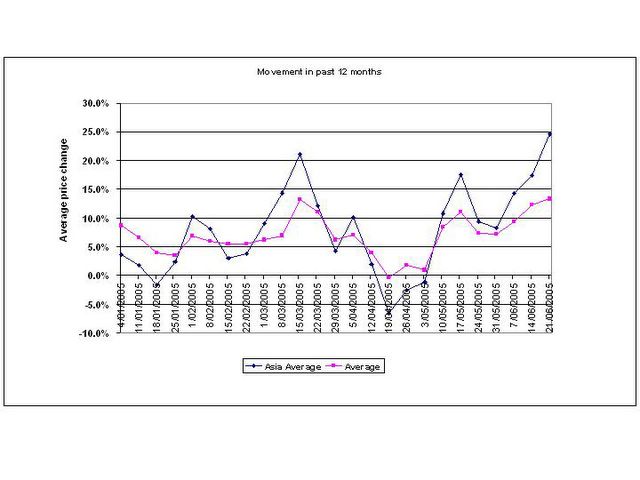
A big surge in Global Sources' share price this week (up 49.3%) has seen Asian stocks on our index soar ahead of the 'whole world' index, pink on this chart. Penton was the biggest faller of the week, back down 15.4%. Click on the chart for a clearer, larger view.

Smarter smart phones spell opportunity
We posted a while back on the untapped potential of mobile phones for business communications. Dan Gilmor today reports on an Intel announcement for a "Smart Chip" that could offer True Global Roaming:
"Intel has announced a new chip (Mercury News) that can send and receive signals from a variety of wireless devices -- 'part of the quest to create phones that could roam across different types of networks in any part of the world.'
(Via Dan Gillmor's blog.)
The potential for being able to roam freely across all of Asia, including Korea and Japan, and, we hope, to switch seamlessly between wi-fi and mobile networks, opens up all sorts of new potential for information products. Tapping more actively into the innovative stream of mobile business that has been developed in Korea would be a boon for everybody....not least the Korean developers.
"Intel has announced a new chip (Mercury News) that can send and receive signals from a variety of wireless devices -- 'part of the quest to create phones that could roam across different types of networks in any part of the world.'
There will be a big market for this kind of thing (and Intel's far from alone in this arena), becuase of all the different mobile standards. My GSM phone only works in some places, inside and outside the U.S.; I'd like it to work wherever I go.
The true holy grail will come with mesh networks that create themselves on the fly and use Internet backbones for long haul traffic, not requiring the control-freakish mobile carriers' networks at all. Not holding my breath."
(Via Dan Gillmor's blog.)
The potential for being able to roam freely across all of Asia, including Korea and Japan, and, we hope, to switch seamlessly between wi-fi and mobile networks, opens up all sorts of new potential for information products. Tapping more actively into the innovative stream of mobile business that has been developed in Korea would be a boon for everybody....not least the Korean developers.
Monday, June 20, 2005
Chinese internet has already overtaken print and radio
It may be on a PR website, but Dominic Powers of Doubleclick provides some interesting insights in his review of the Chinese internet on the UpstreamAsia Newsletter June, 2005:
What particularly caught my eye was this quotation from some recent research
"According to the 2005 IMI Consumer Behavior & Lifestyle Book, the Internet is now occupying almost 22% of total consumer media consumption time (up from 15% in 2004), with the average Chinese online user spending some 13 hours per week over 4.1 days online. This usage trend has already overtaken both radio and print, but in a nation that has the highest volume of television sales anywhere in the world, it still ranks behind TV which enjoys a share of around 55%. "
He also notes that "e-commerce sales in China in 2004 (defined as a transaction where payment actually took place online) totaled some RMB4.2billion, or US$500million".
What particularly caught my eye was this quotation from some recent research
"According to the 2005 IMI Consumer Behavior & Lifestyle Book, the Internet is now occupying almost 22% of total consumer media consumption time (up from 15% in 2004), with the average Chinese online user spending some 13 hours per week over 4.1 days online. This usage trend has already overtaken both radio and print, but in a nation that has the highest volume of television sales anywhere in the world, it still ranks behind TV which enjoys a share of around 55%. "
He also notes that "e-commerce sales in China in 2004 (defined as a transaction where payment actually took place online) totaled some RMB4.2billion, or US$500million".
Saturday, June 18, 2005
A weekend diversion...
Sue Pelletier points the world to one of the stranger web sites we have come across:
What, you may well ask, has all this to do with Asian Business Media? Only that, as Las Vegas comes to Macau, we have to wonder just how bad the carpets might be at South China's newest convention centre when the Venetian opens its doors in CoTai in 2007. Anybody who has ever visited Macau's existing facilities will know that they have the capacity to make Vegas look like a restrained display of good taste in Architectural Digest by comparison.
Casino carpeting: I guess it could be considered art: "Talk about your weird obsessions--David G. Schwartz, who runs the Gaming Studies Research Center at the University of Nevada Las Vegas, is really into casino carpets (here's a link to his online casino carpet gallery. He says on his site:..."
(Via face2face.)
What, you may well ask, has all this to do with Asian Business Media? Only that, as Las Vegas comes to Macau, we have to wonder just how bad the carpets might be at South China's newest convention centre when the Venetian opens its doors in CoTai in 2007. Anybody who has ever visited Macau's existing facilities will know that they have the capacity to make Vegas look like a restrained display of good taste in Architectural Digest by comparison.
Friday, June 17, 2005
Global Sources - eBay B2B link-up throws down the gauntlet to Alibaba
One of the more unexpected announcements of the week has come from Hong Kong-based and NASDAQ-listed Global Sources who are linking up with eBay in China. They say that their new service Global Sources Direct is designed to serve eBay PowerSellers in China.
Perhaps no coincidence that Global Sources' arch rivals in China, alibaba.com has been pouring much of the $80 million it raised last year on financial markets to fund its taobao.com which is giving eBay a run for its money in the consumer auctions market. Alibaba hasn't yet geared Taobao up for B2B activity and, with this announcement, both eBay and Global Sources seem to be taking a step up above it. If it works, it will be one of the few times they have outflanked Alibaba's Jack Ma as the companies vie for supremacy.
Perhaps no coincidence that Global Sources' arch rivals in China, alibaba.com has been pouring much of the $80 million it raised last year on financial markets to fund its taobao.com which is giving eBay a run for its money in the consumer auctions market. Alibaba hasn't yet geared Taobao up for B2B activity and, with this announcement, both eBay and Global Sources seem to be taking a step up above it. If it works, it will be one of the few times they have outflanked Alibaba's Jack Ma as the companies vie for supremacy.
Exhibition centre extension plan backed
The Hong Kong Government has announced that it will permit the HK Trade Development Council to go ahead with its controversial proposed extention of the Hong Kong Convention & Exhibition Centre in Wanchai. The additional 19,400 square metres of space will allow the TDC to expand its large Spring and Autumn sourcing fairs in the face of new competition from Global Sources' China Sourcing Fairs which will be launched at the new AsiaWorld-Expo venue at Hong Kong's airport next year.
The TDC's next task will be to raise the HK$1 billion needed from bankers. No word yet on timing although we assume the TDC will want to press on with this.
The TDC's next task will be to raise the HK$1 billion needed from bankers. No word yet on timing although we assume the TDC will want to press on with this.
Thursday, June 16, 2005
Outsource the editorial....fear and trembling in the news room
Paul Conley points me towards an interesting post on the provocatively-named ContentSutra titled "Outsourcing Is Here To Stay, Even In Media".
India's competencies in technology in particular are well documented. Why would Indian publishers want to license content from their international counterparts when they can produce it themselves for a fraction of the price? The natural extension of that thinking for technical material is, if they can produce it, can they sell it to publishers in other places? Several companies, including newly-listed and Bombay Stock Exchange star performer Cybermedia clearly think so. Not only is the company trying to sell its content, it has also pledged to use the funds acquired in the recent IPO to launch a new international magazine focused on outsourcing.
India's competencies in technology in particular are well documented. Why would Indian publishers want to license content from their international counterparts when they can produce it themselves for a fraction of the price? The natural extension of that thinking for technical material is, if they can produce it, can they sell it to publishers in other places? Several companies, including newly-listed and Bombay Stock Exchange star performer Cybermedia clearly think so. Not only is the company trying to sell its content, it has also pledged to use the funds acquired in the recent IPO to launch a new international magazine focused on outsourcing.
Tuesday, June 14, 2005
Updates on Indian exhibitions
Three speakers at the UFI Seminar in Como talked the delegates through market potential in India. It certainly remains an under-developed market with about 650,000 sq. metres of exhibition sold each year - roughly 8% the total of China.
Modern venues remain in short supply although one speaker, Prem Behl of Exhibitions India, predicted that the new venue in Bangalore, only opened last September, would be considered too small very shortly and that an extension would develop. He was also full of praise for the new ExpoCentre in New Delhi. Less enthusiasm from the speakers for the facilities in Mumbai (Bombay) although there was some encouragement that the Bombay Exhibition Centre - a 50,000 sq. metre converted factory building, is being upgraded. Not before time....
Modern venues remain in short supply although one speaker, Prem Behl of Exhibitions India, predicted that the new venue in Bangalore, only opened last September, would be considered too small very shortly and that an extension would develop. He was also full of praise for the new ExpoCentre in New Delhi. Less enthusiasm from the speakers for the facilities in Mumbai (Bombay) although there was some encouragement that the Bombay Exhibition Centre - a 50,000 sq. metre converted factory building, is being upgraded. Not before time....
Witt to take UFI top spot

Jochen Witt of Managing Director of Koelnmesse, appointed at UFI's Lake Como Board Meeting as the new Incoming President of UFI with effect October 2005 at its Congress in Moscow. This will take effect as Stockholm's Tom Beyer takes over from Ruud van Ingen as President.
Monday, June 13, 2005
Business Magazines Losing Readers in India
The National Readership Survey in India is always controversial. The publication of the 2004 edition was delayed for several months by law suits. This year's NRS shows the three major general business magazines losing readers as Hugo Martin picks up on his blog today.
This is an interesting time for India's publishers as the door to foreign, non-news publishers is now wide open as we reported here on June 2nd. The market has never been particularly strong. BSG estimated last year that the total b2b magazine market was generating revenues of only around $20 - 25 million.
This is an interesting time for India's publishers as the door to foreign, non-news publishers is now wide open as we reported here on June 2nd. The market has never been particularly strong. BSG estimated last year that the total b2b magazine market was generating revenues of only around $20 - 25 million.
Blogging in Japan
Steve Rubel on his Micro Persuasion blog points to an interesting tool for outsiders wanting to search the Japanese Blogosphere. He suggests that there are millions of Japanese blogs.
Given that, for most forms of media, Japan is a bigger market than the rest of Asia put together (including China and India), we will need to return to this to see just how things are developing there.
Given that, for most forms of media, Japan is a bigger market than the rest of Asia put together (including China and India), we will need to return to this to see just how things are developing there.
On the road
Travelling this week to the Summer Seminar at Lake Como for UFI, the Global Association of the Exhibition Industry. Should be an interesting meeting of 250+ of the top people in the trade fair business, mainly from Europe but with a good smattering from Asia and the Middle East too.
I will try to post a few times during the week with updates on what is happening here.
Road warrior note: flew to Italy from Hong Kong on Lufthansa via Munich. LH has just introduced wireless broadband on its long-haul flights and I witnessed a passenger making Skype calls from 35,000' over Russia for the first time! Not sure who he was talking to as it was the middle of the night in Asia (where we had come from) and late Sunday evening in Europe (where we were headed).
I will try to post a few times during the week with updates on what is happening here.
Road warrior note: flew to Italy from Hong Kong on Lufthansa via Munich. LH has just introduced wireless broadband on its long-haul flights and I witnessed a passenger making Skype calls from 35,000' over Russia for the first time! Not sure who he was talking to as it was the middle of the night in Asia (where we had come from) and late Sunday evening in Europe (where we were headed).
Saturday, June 11, 2005
Voices from the Chinese blogging world
More, as promised on the impact of China's internet registration rules on blogging. Some encouraging insights in this 'Skypecast' from Rebecca Mackinnon:
Skypecast with Isaac on China's crackdown: "I spoke to Isaac Mao in Shanghai via Skype to get some clarification and detail about how the latest regulations requiring bloggers to register in China are actually being implemented - and interpreted. The conversation was exremely interesting. As usual,..."
Skypecast with Isaac on China's crackdown: "I spoke to Isaac Mao in Shanghai via Skype to get some clarification and detail about how the latest regulations requiring bloggers to register in China are actually being implemented - and interpreted. The conversation was exremely interesting. As usual,..."
(Via RConversation.)
Friday, June 10, 2005
Cyber Media lists on BSE
India's Moneycontrol.com reports that shares in leading IT publisher Cyber Media have listed at a 25% premium to their Rs60 issue price. On it's opening day in Mumbai, the stock reportedly hit a high of Rs103.80 and was quoting at Rs98.50 when the article was written.
Owner Pradeep Gupta is planning to use the proceeds of the IPO - which makes Cybermedia India's second listed B2B media company - to launch an international outsourcing magazine. The prospects for a planned launch of Business Week in India with McGraw Hill are a little murkier.
Owner Pradeep Gupta is planning to use the proceeds of the IPO - which makes Cybermedia India's second listed B2B media company - to launch an international outsourcing magazine. The prospects for a planned launch of Business Week in India with McGraw Hill are a little murkier.
Literacy is the key
The China vs. India debate continues to run and run with many learned theories about how the systems compare. China Digital Times, for example, quoted the Calcutta Telegraph earlier this week. Infrastructure is often cited, different banking systems, the advantages and disadvantages of parliamentary democracy to economic development. All fascinating and, to some extent relevant.
We wonder, though, and as purveyors of the written word, we wonder hard, why so little is spoken of literacy in the context of economic development. The comparisons are striking:
India adult literacy
Total population: 59.5%
Male: 70.2%
Female: 48.3%
China adult literacy
Total population: 90.9%
Male: 95.1%
Female: 86.5%
The population totals of the two giants of Asia are increasingly similar but, if 40% of that population is excluded from the modern knowledge economy by illiteracy, there will always be a huge drag on how far the country can rise. When over half of the women in the country are excluded from the modern economy, a massive deficit in the development potential can be the only result.
We wonder, though, and as purveyors of the written word, we wonder hard, why so little is spoken of literacy in the context of economic development. The comparisons are striking:
India adult literacy
Total population: 59.5%
Male: 70.2%
Female: 48.3%
China adult literacy
Total population: 90.9%
Male: 95.1%
Female: 86.5%
The population totals of the two giants of Asia are increasingly similar but, if 40% of that population is excluded from the modern knowledge economy by illiteracy, there will always be a huge drag on how far the country can rise. When over half of the women in the country are excluded from the modern economy, a massive deficit in the development potential can be the only result.
...in this week's issue
In this week's BSG newsletter, we have: Concerns over Chinese Internet registration requirements, Dubai expanding facilities, Canberra facilities to be upgraded, SunBiz obtains S$10mn equity line of credit,
SunBiz up, Penton down
BSG tracks the price of 30 B2B media stocks. 12 of them are Asian companies with the remainder multi-nationals with substantial Asian business.
This week, after spooking the market for several months, Panpac (now SunBiz) in Singapore clawed back 23.1% as our best performer. Penton gave back some of its recent gains, slipping 9.5% on the week to record the biggest drop.
More details of the index and individual performance year-to-date and for the past 12 months are included in our weekly newsletter. Sign up for this at our home page.
This week, after spooking the market for several months, Panpac (now SunBiz) in Singapore clawed back 23.1% as our best performer. Penton gave back some of its recent gains, slipping 9.5% on the week to record the biggest drop.
More details of the index and individual performance year-to-date and for the past 12 months are included in our weekly newsletter. Sign up for this at our home page.
Thursday, June 09, 2005
Today's most surprising source of RSS Service
Imagine our surprise to discover that the voice of the Chinese Communist Party is wide awake to RSS and has an easily accessible series of news feeds. The People's Daily Online RSS Service covers everything from the obvious China News to a selection of "top leaders". Daily updates on the wisdom and activities of Luo Gan anybody?
900 million phones and not a B2B application in sight
cmpnetasia.com in Singapore reports from IDC today that there are now over 900 million mobile phones in Asia. Mobile service revenues in the region are now over $100 billion the report says.
Where are the business media and information companies in all of this? Nowhere as far we can see. In large, but hard-to-tap markets like India, China and Japan, why plug away with traditional media strategies that are going nowhere? There is a huge opportunity here, particularly as 3G adoption rates pick up dramatically in markets like Korea, Hong Kong and Australia. We wait for the first move...
Where are the business media and information companies in all of this? Nowhere as far we can see. In large, but hard-to-tap markets like India, China and Japan, why plug away with traditional media strategies that are going nowhere? There is a huge opportunity here, particularly as 3G adoption rates pick up dramatically in markets like Korea, Hong Kong and Australia. We wait for the first move...
Wednesday, June 08, 2005
FEER Travellers' Tales becomes a blog
One of the favourite features of the Far Eastern Economic Review for many years has been its Travellers' Tales column. Featuring wacky facts about Asia, often involving a horrible mangling of the English language, the column reached its peak popularity under the late-editor Derek Davies in the 1980s and his successor Nury Vittachi in the 1990s. We discover that, in the magazine's new iteration as a worthy journal, this column has been turned by the new-look Review's new editor, Hugo Restall into a blog.
He invites contributions by e-mail.
He invites contributions by e-mail.
eMarketer throws Spotlight on China, Japan and South Korea
While it is not particularly our role to plug other people's research reports, eMarketer's new report on Asia-Pacific E-Commerce: Spotlight on China, Japan and South Korea interests us.
It says, quite rightly: "The Asian e-commerce market is not a single market, but rather a collection of economies at markedly different stages of maturity. Japan is the most robust, although per capita online spending lags the US by a wide margin, suggesting that there is plenty of room for growth. But the market with the greatest potential for growth appears to be China."
Key take home point: despite all the hype, China is a tiny e-commerce market today with sales of $1.1 billion againgst Japan's $38.4 billion. It ties with Taiwan for third place after South Korea in second with $6.3 billion in sales. The report falls back on the cliche that it is the market of the future. It probably is, and Charles de Gaulle's comment on Brazil ("...and always will be") is probably not justified in this case. But, there is a long way to go before good profits are to be made in most sectors of e-commerce.
It says, quite rightly: "The Asian e-commerce market is not a single market, but rather a collection of economies at markedly different stages of maturity. Japan is the most robust, although per capita online spending lags the US by a wide margin, suggesting that there is plenty of room for growth. But the market with the greatest potential for growth appears to be China."
Key take home point: despite all the hype, China is a tiny e-commerce market today with sales of $1.1 billion againgst Japan's $38.4 billion. It ties with Taiwan for third place after South Korea in second with $6.3 billion in sales. The report falls back on the cliche that it is the market of the future. It probably is, and Charles de Gaulle's comment on Brazil ("...and always will be") is probably not justified in this case. But, there is a long way to go before good profits are to be made in most sectors of e-commerce.
Concerns over Chinese registration rules.
A good deal of comment in the blog world as well as among media companies with on-line activity in China as the enforcement of web sites (including blogs) begins to bite. Dan Gilmor refers to BBC reports and a piece by former CNN reporter Rebecca MacKinnon in his Chinese Bloggers Threatened Again on Bayosphere.
We will continue to track this very closely.
We will continue to track this very closely.
Tuesday, June 07, 2005
Interfax reports China using new "Night Crawler System" to monitor internet
China Digital Times reports from Interfax that China is using a new "Night Crawler System" to monitor internet and close unregistered websites. We are assuming that this system works within the "Great Firewall of China" but the news provides an interesting insight into how relatively efficient the authorities have become at patrolling cyber-space and how concerned they remain about it.
Google vs. B2B?
Lots of posts overnight about Google's research from Millward Brown on how it is more effective than B2B trade magazines. The one I have liked the best so far is at ABM's MediaPace : Setting the pace for business-to-business dialogue: Google research -- search vs. print?.
My view on this is that the argument that search is a more effective first step in a purchasing research process than browsing magazines is a no-brainer. Of course it is! But whether those ads themselves are more effective and whether they serve the same purpose as the ads in business magazines is much more open to question.
And I am intrigued by the argument that Google is not siphoning revenues at all but acting as an ad agency. The success of that argument depends, I suppose, on the extent to which searchers are still going to use home pages at the traditional media companies rather than Google's own or web-only sites.
In Asia, where B2B ad revenues are so relatively low to start with, all is still to play for.
My view on this is that the argument that search is a more effective first step in a purchasing research process than browsing magazines is a no-brainer. Of course it is! But whether those ads themselves are more effective and whether they serve the same purpose as the ads in business magazines is much more open to question.
And I am intrigued by the argument that Google is not siphoning revenues at all but acting as an ad agency. The success of that argument depends, I suppose, on the extent to which searchers are still going to use home pages at the traditional media companies rather than Google's own or web-only sites.
In Asia, where B2B ad revenues are so relatively low to start with, all is still to play for.
HKTDC reports on Beijing ad regulations
The Hong Kong Trade Development Council reports on moves in Beijing to stem exaggerated and fraudulent ads.
Many will say "not before time" and others will add "and good luck with enforcing it". Getting the right regulations in place is always a good first step. But, in a country as large and complicated as China, enforcing those regulations at all, let alone widely and even-handedly can be a significant challenge.
Many will say "not before time" and others will add "and good luck with enforcing it". Getting the right regulations in place is always a good first step. But, in a country as large and complicated as China, enforcing those regulations at all, let alone widely and even-handedly can be a significant challenge.
Monday, June 06, 2005
What's real in Korea?
Paul Conley directed me towards Dan Gilmors Blog and I immediately focused on this post. He gets quickly to the point that things work in Korea a bit more differently that many of us think on a first look. It's worth scratching the surface there to work out what is really happening. Interesting place:
Korea Bloggers, Press Freedoms: "In one of the most connected places on the planet, blogging is thriving. But it's just one of many forms of online communication.
Last evening Joi Ito and I joined a small group of Korean bloggers at a local restaurant.
I had to leave the party early, but I learned a bit about the local scene. Koreans are taking to the blog format, but they do it differently. For example, linking out isn't as common as with U.S. bloggers, who make it a practice to point to other people's material. I'm still not sure why this is the case.
The day before yesterday, I stopped off at OhmyNews, the pathbreaking site that combines citizen journalism with professional standards. How? They edit the articles, or at least many of them. They work with the citizen reporters, with fact-checking and training sessions.
The major newspapers are obviously not fond of OhmyNews, which was created in part as a counterweight to their overwhelming influence. The country's president, Roh Moo-hyun, took a shot at the Korean press in a speech Monday, when he officially welcomed members of the global newspaper industry to the nation for several conferences including the World Editors Forum conference that brought me here.
Korea has a new press law. I'm not entirely sure, even after speaking with a number of local experts, that I understand it well enough to comment intelligently. But it seems to be a fairly direct attack on the power of the major newspapers and other dominant media, and it has generated pushback from the press in a general sense.
I'm no fan of media concentration. I'm even less of a fan of overt government interference in journalism.
The advent of a serious online media here is good news for all Koreans. It will be more difficult to control, by whatever means."
(Via Dan Gillmor's blog.)
Amex and Asian b2b
With due deference to the efforts of the PR industry, we report on an intriguing tie-up between American Express and the MICE industry sub-title of TTG Asia, the Asian region's leading travel trade publisher.
TTGmice...has announced a tie-up with American Express to produce the upcoming 2005/2006 edition of the annual TTGmice Planner.
The collaboration allows MICE planners to take advantage of discounts offered by participating vendors whenever payments are made using any American Express card. In addition, advertisers in this year’s planner will gain additional exposure as 5,000 extra copies will be delivered to the corporate clients of American Express. The planner will also be delivered to the more than 13,000 MICE industry members in Asia-Pacific who already receive TTGmice.
Whether as well as or instead of advertising, we'll have to see how the next edition of the 'Planner' looks. But multiple revenue streams are all the rage in the world of B2B and it's good to Asian publishers getting in on the act.
TTGmice...has announced a tie-up with American Express to produce the upcoming 2005/2006 edition of the annual TTGmice Planner.
The collaboration allows MICE planners to take advantage of discounts offered by participating vendors whenever payments are made using any American Express card. In addition, advertisers in this year’s planner will gain additional exposure as 5,000 extra copies will be delivered to the corporate clients of American Express. The planner will also be delivered to the more than 13,000 MICE industry members in Asia-Pacific who already receive TTGmice.
Whether as well as or instead of advertising, we'll have to see how the next edition of the 'Planner' looks. But multiple revenue streams are all the rage in the world of B2B and it's good to Asian publishers getting in on the act.
The classified free sheet in Asia
A report in London's Guardian Unlimited on the New York Times plans for a free weekly for commuters set us thinking about this phenomenen in Asia, the impact of the Internet on it and the potential impact for B2B.
Metro has already established itself in Hong Kong and Seoul. It claims to be the third most read newspaper in Hong Kong.
Generally, most B2B weeklies in Asia have never succeeded in pulling in much classified advertisng. The big city newspapers such as Hong Kong's South China Morning Post and Singapore's Straits Times have for many years appeared more attractive to most corporate advertisers seeking staff than small circulation B2B magazines.
The Internet doesn't seem to have changed that too much with most major newspapers offering on-line add-ons to their existing classified packages.
The free sheets are now mopping up most of what low-end classified ad business there was for the B2B publishers. Haymarket's Media is a notable exception and we shall be interested to see if others have any success in emulating what it does.
Metro has already established itself in Hong Kong and Seoul. It claims to be the third most read newspaper in Hong Kong.
Generally, most B2B weeklies in Asia have never succeeded in pulling in much classified advertisng. The big city newspapers such as Hong Kong's South China Morning Post and Singapore's Straits Times have for many years appeared more attractive to most corporate advertisers seeking staff than small circulation B2B magazines.
The Internet doesn't seem to have changed that too much with most major newspapers offering on-line add-ons to their existing classified packages.
The free sheets are now mopping up most of what low-end classified ad business there was for the B2B publishers. Haymarket's Media is a notable exception and we shall be interested to see if others have any success in emulating what it does.
Sunday, June 05, 2005
Problems we'd all like to have
The Taipei Times reports on a problem most trade fair organisers would give their right arms for: space constraint at one of the world's largest IT events, Computex. The fact that the story involves mainland Chinese companies trading space with Taiwanese counterparts add spice to it.
Computex appears to have thrived despite the general move away from large, general IT events, despite the relocation of many Taiwanese IT companies into the mainland and despite less than ideal exhibition facilities for such a large event. That last constraint will be solved next year when the new hall opens in Nankang and, with people so eager to get in, the future of the show looks pretty solid.
Computex appears to have thrived despite the general move away from large, general IT events, despite the relocation of many Taiwanese IT companies into the mainland and despite less than ideal exhibition facilities for such a large event. That last constraint will be solved next year when the new hall opens in Nankang and, with people so eager to get in, the future of the show looks pretty solid.
Saturday, June 04, 2005
When hackers attack, you know the market's reached critical mass
This report on CNN about how Microsoft's MSN site hacked was in South Korea tells us some interesting things about how the market is developing:
1. It is now already big enough to be worthy of serious hacker attack. We probably already knew that: the broadband wiring of the South Korean Internet has been widely reported. But I believe we will be seeing more of this across Asia as other markets like India and China reach serious usage levels.
2. S. Korea leads Asia's online gaming industry. This is putting enormous strains, for example, on fibre capacity between China and Korea. The inter-connection of different countries in the region and their inter-dependence in the information industry is a topic to which we shall no doubt return.
This touches on just a couple of the issues posed for regulators by Broadband, wi-fi and the other technical developments under-pinning much of the information/media revolution sweeping Asia as it is the rest of the world. Widespread and high-speed access is widely seen by most governments in the region as an essential component of their development. It is. But, as Deng Xiaoping is reputed to have said "When you open the windows, flies will come in too". Remember, also, his less-quoted second sentence "We say, 'Open the windows, breathe the fresh air and at the same time fight the flies and insects'". Watch how they fight and what they consider to be flies.
1. It is now already big enough to be worthy of serious hacker attack. We probably already knew that: the broadband wiring of the South Korean Internet has been widely reported. But I believe we will be seeing more of this across Asia as other markets like India and China reach serious usage levels.
2. S. Korea leads Asia's online gaming industry. This is putting enormous strains, for example, on fibre capacity between China and Korea. The inter-connection of different countries in the region and their inter-dependence in the information industry is a topic to which we shall no doubt return.
This touches on just a couple of the issues posed for regulators by Broadband, wi-fi and the other technical developments under-pinning much of the information/media revolution sweeping Asia as it is the rest of the world. Widespread and high-speed access is widely seen by most governments in the region as an essential component of their development. It is. But, as Deng Xiaoping is reputed to have said "When you open the windows, flies will come in too". Remember, also, his less-quoted second sentence "We say, 'Open the windows, breathe the fresh air and at the same time fight the flies and insects'". Watch how they fight and what they consider to be flies.
Focus on international B2B
Interesting piece today on Paul Conley's blog which kindly makes reference to our site. For those watching Asia, the Colin Crawford piece on IDG in Vietnam he references is particularly interseting.
B2B media in the global economy: "'Do you speak any other languages?'
That's one of the first questions I ask journalism students and newcomers to our industry. Just as our industry is being changed by new media, our customers' businesses are being changed by a global economy. The B2B publisher who understands that will prosper. The journalist who is prepared to report from Asia, the Middle East, Eastern Europe, Africa, etc. is worth three English-only staffers.
It's always fun to track developments in international B2B. And in recent days I've come across some new sources of information.
Check out Colin Crawford's blog. Colin works for IDG, a big player in overseas markets, which just increased its investments in Vietnam.
Then take a look at Paul Woodward's site. Paul tracks B2B media in Asia. Among the things I learned from his blog is that CMP is closing some Singapore-based print publications (while keeping a tech-centered Web site.)
And don't forget Hugo Martin, who follows B2B developments across the globe from Berlin.
And make sure you bookmark the website of Trade, Association and Business Publications International, the group that works 'to bring together editors working for English-language publications worldwide, and encourage a common dedication to editorial ethics and excellence.'"
(Via paulconley.)
Friday, June 03, 2005
Betty goes to Hollywood
Betty Heywood, formerly a director of Messe Frankfurt (Hong Kong), has been appointed as the director of international affairs for the NAMM, the California-based association of the music industry. NAMM notes in its press release that Betty "is best known within the music products industry for launching and managing the Music China show since 2002".
BSG's weekly newsletter this week
In Asia Business Media News Update #137 published today, the following stories are highlighted:
In this issue: CMP pulls out of print in Singapore, 100% ownership for non-news print in India, SunBiz sells Auston, Key appointment at Business Week Asia, HC International sells ad sales business, Copyright protection on-line in China
To receive this newsletter every week, including BSG's tracking of listed Asian B2B media companies and those listed international B2B media companies with Asian business, sign up at the BSG web site.
For a copy of this week's newsletter, e-mail Jess Wong.
In this issue: CMP pulls out of print in Singapore, 100% ownership for non-news print in India, SunBiz sells Auston, Key appointment at Business Week Asia, HC International sells ad sales business, Copyright protection on-line in China
To receive this newsletter every week, including BSG's tracking of listed Asian B2B media companies and those listed international B2B media companies with Asian business, sign up at the BSG web site.
For a copy of this week's newsletter, e-mail Jess Wong.
Thursday, June 02, 2005
100% ownership for non-news titles in India
Exchange4media reports that the Indian government has lifted the 74% cap on foreign investment in non-news print media opening the door for wholly foreign-owned publishing in most magazine and journal sectors. Investors will still need clearance from the Ministry of Information & Broadcasting as well as the Foreign Investment Promotion Board and the Reserve Bank of India.
The definition of "non-news" is open to some debate as McGraw Hill and Cybermedia have found in their efforts to launch an Indian edition of Business Week.
At the same time, the Indian industry is debating government plans to set up a Media Regulatory Authority. One well-known TV journalist is reported as saying ""Maddening competition in the media, especially TV, which was rendering it incapable of self-regulation".
The definition of "non-news" is open to some debate as McGraw Hill and Cybermedia have found in their efforts to launch an Indian edition of Business Week.
At the same time, the Indian industry is debating government plans to set up a Media Regulatory Authority. One well-known TV journalist is reported as saying ""Maddening competition in the media, especially TV, which was rendering it incapable of self-regulation".
Electronic revenues in Asia
Multiple articles today on Outsell's research suggesting that "signficant ad revenues" were migrating from magazines and newspapers to Yahoo, Google and the like. We wonder how this will develop in Asia where, outside Japan, critical mass has never been reached in b2b print advertising even in the big markets like China and particularly in India.
Meanwhile, Plastics News China eWeekly e-newsletter and web site debuted yesterday with solid support from advertisers.
Meanwhile, Plastics News China eWeekly e-newsletter and web site debuted yesterday with solid support from advertisers.
Wednesday, June 01, 2005
Hui Cong pulls back from TV ad sales
HC International, Inc., the Hong Kong-listed parent of China’s Hui Cong, has announced the transfer of its entire 100% interest in China Media Network International Inc. ('CMN') to the NASDAQ-listed Metaphor Corp. (MTPH.OB). HC will receive 28.68% of Metaphor’s shares and a US$3,785,000 cash payment.
The company says that it will realise a gain of approximately RMB38.1 million (US$4.9 million) from the disposal of its CMN interest. It says that it will use 60% of these proceeds to expand its existing fast-growing portal business by exploring overseas markets and pursuing mergers and acquisitions.
In its most recent SEC filing (a 10 SQB), Metaphor says of the transaction that "we would acquire certain assets from an Asian company along with the gross proceeds of an equity or debt financing which amounted to not less than USD $15,000,000".
The company says that it will realise a gain of approximately RMB38.1 million (US$4.9 million) from the disposal of its CMN interest. It says that it will use 60% of these proceeds to expand its existing fast-growing portal business by exploring overseas markets and pursuing mergers and acquisitions.
In its most recent SEC filing (a 10 SQB), Metaphor says of the transaction that "we would acquire certain assets from an Asian company along with the gross proceeds of an equity or debt financing which amounted to not less than USD $15,000,000".
B2B web site ratings updated
Our B2B web site ratings have been one of the more controversial items in our weekly newsletter. We use alexa.com as the least unreliable source of traffic data across a range of sites and keep a ranking of those in Asia which are in the top 500,000 sites worldwide. The count is currently just 46. Those who don't rank as highly as they would like (and you know who you are) have questioned the validity of the numbers. We understand their point although don't yet have a better alternative.
The numbers, as calculated at the end of May, give the following top 10:
1. Alibaba.com
2. hc360.com
3. Made-in-china.com
4. Globalsources.com
5. ec21.com
6. chinabyte.com
7. efu.com.cn
8. tdctrade.com
9. zdnet.com.cn
10. 51fashion.com.cn
Of these, only one, ec21.com, operates outside China. It is Korean. And only one of them, zdnet.com.cn is produced by a recognised media multi-national.
Our extrapolation of the Alexa data, suggests that Alibaba has around 6.5 million regular users while the #10, 51fashion, has around 125,000.
Last hurrah for print?
Paul Conley, in his excellent blog of the same name talks about the 'death of print' following the news that Thomas Register will no longer print its famous directory.
I was having a related conversation yesterday with the CEO of one of Asia's leading B2B companies. This may be the time at which we see all the most interesting developments taking place in the electronic arena and a quick demise of B2B print, particularly in English. Geographical, historical and economic reasons mean that English-language print media has been, to put it mildly, troubled in Asia for many years.
Experiments like those recently announced by Crain with Plastics News China and Ad Age's China newsletter suggest that publishers are finally beginning to look really seriously at electronic alternatives in this part of the world.
Thomas Register drops print: "
You can argue all day about whether or not print is dead. Lots of folks like to do that.
But at Thomas Register, the argument is over.
Thomas says the 2006 edition of the Thomas Register of American Manufacturers will be last print version of the industrial directory.
"But at Thomas Register, the argument is over.
Thomas says the 2006 edition of the Thomas Register of American Manufacturers will be last print version of the industrial directory.
I was having a related conversation yesterday with the CEO of one of Asia's leading B2B companies. This may be the time at which we see all the most interesting developments taking place in the electronic arena and a quick demise of B2B print, particularly in English. Geographical, historical and economic reasons mean that English-language print media has been, to put it mildly, troubled in Asia for many years.
Experiments like those recently announced by Crain with Plastics News China and Ad Age's China newsletter suggest that publishers are finally beginning to look really seriously at electronic alternatives in this part of the world.